


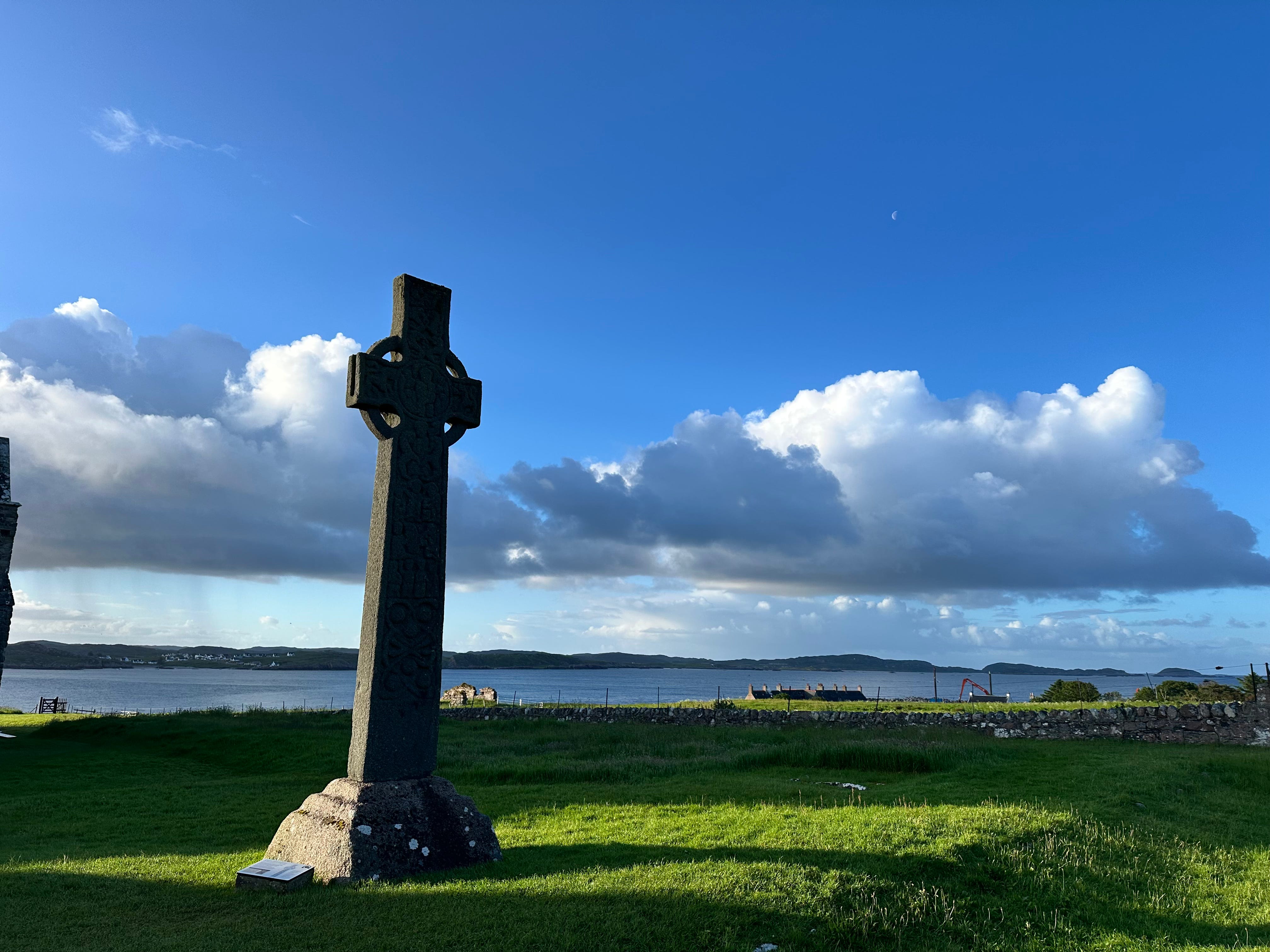
What if we believed, I mean really believed, that we belonged to one another?
This became a central question during my time on Iona last week. Now, Iona if you do not know, is one of the centers of the development of early Christianity, particularly for the British Isles. It was for many years, isolated from the influence of the Roman Empire, and had the freedom to consider the teachings of Jesus in a holistic way that was grounded in the Celtic belief that God was deeply embodied in all of creation. John Philip Newell refers to this embodiment as the Cathedral of Earth, Sky and Sea. The cathedral not as an institution but as a source of God’s presence within and around us all.
For these early Celts, there was a sense of equality and justice. Of respect and unity. You couldn’t look at an animal or a human without seeing the face of God. You might say it was a theology that broke every single boundary of religious dogma and stood to question any form of religion that desired to build walls of exclusivity.
At its heart, Celtic Christianity teaches that we belong to one another.
But over the years, as empires collided and Christianity became a voice of the powerful, the Celtic teaching of God’s oneness with creation became threatening. People needed enemies. They desired influence. And they needed God on their side. And so the Celtic message was pushed aside and forgotten in many Christian circles.
When I look out at the religious landscape right now, there are two things that I see…I see beauty and hope…in certain circles. But in other circles, I see division. A split in the fabric of how we define “good” Christianity. And that divide shows up in so many ways. We don’t agree on LGBTQ inclusion, so we break from our denomination. We don’t agree on the ordination of women, so we create our own church that feels a little more comfortable. We want to align ourselves with one political party over another and so we exclude any religious expression that might feel too liberal or too conservative. We begin separating ourselves into religious categories, not belonging to one another but living separate from one another.
The early expression of Celtic Christianity would have found this to be the antithesis of what they were learning about Jesus and about the love of God. And yet, when I read our text from Matthew, I am reminded that religious expression was rarely able to hold onto the Celtic ideal. Or we might even go so far as to say that religious expression has rarely been able to hold onto Jesus’ ideal.
Division. Conflict. Fighting. All in the name of someone’s definition of faith. Man against father, daughter against mother. So it makes me wonder…what is Jesus trying to teach us in our Gospel reading?
Let’s go back to my original question…what if we believed that we belonged to one another?
Early Celtic Christianity gives us a useful way to interpret this text. It held two very important foundational beliefs…the first is that life is made up of both dark and light, joy and sorrow, death and life. Religion didn’t promise an absence of darkness for these earlier followers of Jesus. Instead, it provided a way to mend and heal that which was broken. Religion was a way forward, not in avoidance of hardship but in hope for restoration. Faith didn’t provide easy answers, but it did provide divine assurance of a loving God walking right in the midst of our pain. A God who directed us to see light shining forth even when man is against his father and daughter is against her mother.
The second foundational belief is that God is embodied in all of the earth…in nature, in all living creatures, in all of humanity. So even in our differences, God is with each and every one of us. To not just live side by side but to live in mutuality under the guidance of this God who encompasses all of our lives into one corporate life-giving spiritual path.
So when Jesus acknowledges in Matthew that families and communities will be torn apart, he is naming a truth at the heart of humanity. There is darkness. There is division. We are not immune to such struggles. But in naming this, Jesus is calling us forward out of what separates us into what unites us.
And right there, in that calling forth, is the heart of the Gospel message unadulterated by denominational, nationalistic, or political agendas. And that message asks one very important question…Can we see the face of God in one another, especially when we are divided? Can we belong to one another when it may be easier to isolate, blame, and disregard?
All too often it’s easier to choose the latter. We do it all the time…we put on a good face, pretend everything is just fine and hope the problems go away whether we caused them or not. Maybe we are too proud or confused or embarrassed to confess our complacency or our participation when confronted with brokenness…in our families, in our workplaces, in our communities. We keep the “peace” at whatever cost while allowing hurt to perpetuate.
In other words, we look for the face of God where it is convenient.
John Philip Newell calls this “selective sacredness.” And he says that the Celtic tradition would refer to this as soul-forgetfulness where we have forgotten who we are and have fallen out of true relationship with the earth and with one another.[1] We forget how to belong to one another.
Esther De Waal, author of “The Celtic Way of Prayer” provides a beautiful image of life-giving belonging as ““Life lived under the shadow of God’s outstretched arm.”[2] And that outstretched arm isn’t selective. It is expansive reaching out to every inch of creation, bringing it in and holding it. Loving broken relationships into healing. Loving divided communities into unity. Loving you and me into wholeness.
That is Jesus’ desire for us.
I want to leave you with a portion of a Celtic blessing. This blessing was a part of a collection of ancient prayers that were passed down from generation to generation. A way of praying for expansive belonging for all of creation. As you listen to these words, I want you to imagine the shadow of God’s outstretched arm bringing peace and hope and healing to whatever brokenness you may experiencing.
BLESSINGS
God’s peace be to you,
Jesus’ peace be to you,
Spirit’s peace be to you
And to your children.
Oh to you and to your children.
Each day and night
Of your portion in the world.
My own blessing be with you.
The blessing of God be with you.
The blessing of Spirit be with you
And with your children.
With you and with your children.
The love and affection of the angels be to you.
The love and affection of the saints be to you.
The love and affection of heaven be to you,
To guard you and to cherish you.
May God shield you on every steep,
May Christ aid you on every path,
May Spirit fill you on every slope.
On hill and on plain.[3]
[1] Newell, John Philip. Sacred Earth, Sacred Soul: Celtic Wisdom for Reawakening to What Our Souls Know and Healing the World. HarperOne, 2021. p.3.
[2] de Waal, Esther. The Celtic Way of Prayer: The Recovery of the Religious Imagination. Doubleday, 1997. p.73.
[3] Carmichael, Alexander, ed. Carmina Gadelica: Hymns and Incantations. Floris Books, 1992.
Thank you!
Way to go my friend!